FAILURE TO FULFIL OBLIGATIONS UNDER ARTICLE 258 TFEU: NATIONAL
MEASURES IMPOSING INAPPROPRIATE AND IMPRACTICABLE REQUIREMENTS CONTRARY TO
THE FREEDOM OF MOVEMENT OF UNION CITIZENS
This letter constitutes a formal complaint to the European Commission under
Article 258 TFEU regarding systemic failures by the Republic of Slovenia to
comply with Directive 2004/38/EC, the Charter of Fundamental Rights of the
European Union, and Regulation 2016/679 (GDPR).
Directive 2004/38/EC entered into force on 30 April 2004. Member States were
required to take the necessary measures to implement this Directive in
national law by 30 April 2006.
The complainant fully emigrated to Slovenia from the UK between these dates,
effective 29 April 2005.
In a core obligation under Article 16 Slovenia must grant permanent
residence status to any Union citizen who has resided legally and
continuously for five years.
Once granted, permanent residence triggers equal treatment in key areas
(including full access to social security and healthcare benefits —
Article 24) and stronger protection against expulsion or loss of status.
Slovenia transposed the Directive via the Aliens Act (Zakon o tujcih).
However, official EU implementation reports and Commission assessments noted
significant shortcomings in Slovenia’s transposition and application
of Directive 2004/38/EC. These included incomplete or incorrect
implementation of provisions concerning the continuity of residence and
acceptable absences, equal treatment under Article 24, procedural
safeguards, and the precise conditions for acquiring the right of permanent
residence under Article 16.
Europe-wide, incorrect rules on continuity of residence and calculation of
the five-year period for permanent residence were leading causes of
complaint.
The Commission's 2008 report concluded that Austria, Denmark, Estonia,
Slovenia and Slovakia had correctly adopted less than 60% of the Directive's
provisions — the worst performing cohort. The overall transposition of
Directive 2004/38/EC was rated "rather disappointing" — not one Member
State transposed the Directive effectively and correctly in its entirety,
and not one Article was correctly transposed by all Member States. EUR-Lex
Slovenia specifically had documented problems with permanent residence rules
and administrative discretion. https://eur-lex.europa.eu/LexUriServ/LexUriServ.do?uri=COM:2008:0840:FIN:en:PDF
While Slovenia avoided the very first wave of infringement proceedings for
late transposition (together with a small group of other Member States),
substantive issues persisted in the correct application of key provisions,
particularly regarding the calculation of the five-year period for permanent
residence rights and the treatment of pre-transposition residence periods.
The Directive (and Slovenia's own implementing law) defines continuity with
generous allowances (absences ≤6 months at a time or ≤10 months total
in any 5-year period). Here, the total period of absences from Slovenia in
21 years amounts to less than six months.
But neither continuity alone, nor combined with home ownership, nor with the
duration provided under 2004/38/EC Article 16, were evidence enough of
permanence for Slovenia.
Five years continuous residency should have been completed by 29 April 2010.
Instead, during this first five years the permits silently expired. When the
complainant showed up at the Upravna Enota it always came across as
surprised and disappointed he was still around and hadn't been anywhere,
which would have meant starting the five years all over again. On 18 July
2008 the UE decided to start the five years over again for its own
administrative convenience instead.
The complainant had been unceremoniously wiped or deflagged. The system
still incorrectly described the complainant as living permanently in the UK.
The UE didn't know how to make the system revive a resident, and staff were
habituated in a rather uninventive way to registering new ones and letting
them fall off the register when they didn't miraculously reappear by the
appointed deadline.
Possibly the complainant was misflagged in some way to elude the requirement
of Article 16 and this created a further motive to reboot the permit.
The complainant never ignored any invitations to the UE. Although frankly as
a homeowner with a house to renovate, renewing this unimpressive and
otherwise pointless scrap of paper was a low-priority chore, one with which
the complainant was however late only once.
The UE used this opportunity to restart the five-year clock, despite having
no legal authority to do so.
It is hard to separate their possible motivations. However, the fait
accompli of the reboot was certain to make no difference to the
complainant's insurance status at the time.
And there was no other choice. It is now clear every foreigner needs a full
time lawyer to navigate proceedings in which administrative errors are
treated as the applicant's problem.
The news that the five-year clock had been set to zero after 3 years 2
months 19 days became apparent only after the single/simple option had been
taken.
Incentivised by poor design, the UE acted beyond its legal authority to
delay the Article 16 entitlements to the complainant for banal reasons
invented by the staff themselves, causing economic, health, and welfare
havoc.
The complainant was misled from the outset concerning Slovenia's
bureaucratic welcome. Rather than having "the right of residence in the host
Member State for a period not exceeding three months without being subject
to any conditions or any formalities other than the requirement to hold a
valid identity card or passport" visitors or immigrants to Slovenia (EU/EEA
or not) were expected to register or be registered with the police station
within three days of arrival. The complainant was told this bizarre
militaristic requirement applied as if it was a matter of national
importance. In fact this only applied to TCNs, and was contrary to Articles
8 and Article 9 of 2004/38/EC.
Additionally during this confusing early period the complainant was told the
path to permanence - now known to refer to Article 16 - was six years, not
five.
Six years was the minimum time for TCNs under Article 9(4) of 2003/109/EC
for which you could be absent, and by implication late with your renewal,
before your continuity actually expired. Whereas as an EU citizen the
complainant fell under 2004/38/EC with a discontinuity period of two years -
discrepantly more onerous for EU citizens than TCNs.
Obviously the UE didn't mention 2004/38/EC.
According to the UE, the late renewal of 18 July 2008 would delay the
possibility of a permanent residence permit until 18 July 2013, when a
language test would also be required.
The UE's misrepresentation of the legal position, combined with the absence
of accessible language provision, meant the complainant never sought to
apply.
In the end it took 13 years 5 months 10 days, according to UE records. And
no test. Because there was never supposed to be a test.
In no way was the complainant advised that after five real years Slovenia
was under a positive obligation to grant permanent residence status. Quite
the opposite. It was all about the language Slovenia wished the complainant
could speak.
Under EU law administrative causes cannot break continuity. No exceptions
for reasons such as "Your permit is not important enough to us for us to
send you a warning about its expiry"; or "It's easier to get the computer to
cooperate if we start again"; or "We have made up a special rule for this
and hidden it somewhere" or "Getting what you should have is harder than you
think" are specified in the Directive.
CJEU case law is crystal clear: a Member State cannot rely on its own
administrative shortcomings to deny an EU right (principle of effectiveness
+ sincere cooperation under Article 4(3) TEU). The clock keeps running if
you are factually residing legally and the only interruption was the
authorities' own inefficiency.
During the first five years, the complainant ping-ponged between the ZZZS,
UE and CSD, seeking answers to no avail. Shrugging everywhere.
The cumulative effect was one of deliberate opacity — a combination of
procedural error, misinformation, and disproportionate requirements.
It was clear even then the Upravna Enota held the key to the other kingdoms.
It has latterly become clear that these were Article 16 entitlements and
that the UE did not behave as prescribed.
The UE's delay, caused by its own paperwork failure, is a direct violation
of the Directive, which applies regardless of the inappropriate reboot of 18
July 2008.
Full access to the public health and welfare system is one of the
equal-treatment rights that flows automatically from permanent residence
status under the Directive (cross-referenced with Regulation 883/2004 on
social security coordination).
The complainant was held in temporary status with the possibility of only
exorbitant private insurance, over 100 euros a month in 2005.
In a September 2012 language-related assault the complainant suffered a
cerebrovascular event.
Rehabilitative treatment had to be forgone due to the lack of insurance and
the complainant's health took an irreversible downward step. 75 euros was
spent confirming the diagnosis. The health consequences were lasting and
some were irreversible.
After the second expiry of the five years as envisioned by the UE, temporary
residency still equalled exclusion due to the perception that the language
test would apply. By a combination of misinformation and
miscommunication the complainant came to accept temporariness as an eternal
condition.
Even as immigration increased, and teacher numbers remained low and
unchanged, Slovenia raised its language barriers.
The A1/A2 language test that did exist during the complainant's long hike to
permanence was the ZRSZ job-seeker registration requirement, applicable only
to TCNs registering as unemployed, not a condition of permanent residence.
Third-country nationals are required to pass the breakthrough level A1 exam
within one year of registering with the Employment Service of Slovenia
(ZRSZ). For EU citizens taking the exam is not a condition for registering
as an unemployed person.
So the UE appears to have transposed a condition from one context (TCN
job-seeker registration) into a different one (permanent residence), applied
it to someone it did not legally apply to (an EU citizen), and maintained
this fiction for years before the condition even existed in the form being
claimed.
The UE's "all foreigners are the same" approach tilted towards Slovenia's
language wish fulfilment rather than its legal obligations.
The complainant did without health services or prescription medicines and
could not obtain permanent residence status until the Brexit bilateral
arrangement forced Slovenia to crystallize the complainant's status, that
this might be reciprocated for Slovenians in the UK.
At this time the number of Slovenians in the UK was several times that of UK
citizens in Slovenia. This asymmetry accounts for the atypical alacrity with
which Slovenia regularised UK nationals' status once Article 50 was
triggered. It shows the UE was jolted into awarding the complainant's rights
- up to then stubbornly denied - out of self interest.
Moreover by relaxing imaginary restrictions and presenting the
"regularisation" as a concession rather than acknowledging a mistake since
29 April 2010, the effects of the Agreement were used to whitewash prior
Article 16 entitlements which by 2018 should have been long settled.
Slovenia presented the removal of a non-existent obstacle as an act of
generosity. Past error, far from being acknowledged, was clothed in generous
apparel.
Whatever the UE's rosy view of its own actions, the true chronology is that
the complainant's rights were only recognised after a decade of delay and 13
years of residence, and then only as a result of an unrelated bilateral
agreement. The UE's delay, caused by its own paperwork failure, is a direct
violation of the Directive, which applies regardless of the inappropriate
reboot of 18 July 2008.
You might think the granting of permanent residence in October 2018 would
have at last resolved the insurance situation. No such luck. Full
entitlement to health insurance under the compulsory ZZZS system was denied
for even longer, awaiting Slovenia's 2024 reorganisation of its health
insurance system and the abolition of voluntary supplementary contributions,
for no particular reason.
The ZZZS denial was a downstream consequence of the UE's residence
registration failure: temporary status in the UE's records produced
ineligibility in the ZZZS system, and the 2024 reform that finally triggered
insurance access did so by legislative accident rather than by correction of
the underlying error.
While the reform triggered regularisation for several groups it was entirely
irrelevant to the complainant’s pre-existing rights under Article 16.
Permanent residence granted by the UE did not automatically generate a ZZZS
registration and the complainant was by then long habituated to
institutionally induced resignation. Repulsion at the UE's linguistic
barricades was by now a firm expectation. A right recognised on paper in
October 2018 was not activated in practice until 5 May 2025 — when the
complainant finally received an invitation to register.
The eventual issuance of a ZZZS health insurance card on 5 May 2025 came 6
years, 6 months and 27 days late relative to permanent residence, and 15
years and 6 days late relative to the Article 16 entitlement of 29 April
2010.
The denial of access to the ZZZS health insurance system and associated
welfare entitlements from 29 April 2010 to 5 May 2025 constitutes an
independent breach of Article 34(2) of the Charter of Fundamental Rights of
the European Union, which became binding primary EU law on 1 December 2009
and requires no transposition. It guarantees social security benefits and
social advantages to everyone residing legally within the Union.
This right operates at the level of primary EU law and is not qualified by
the administrative failures that delayed formal recognition of the
complainant's permanent residence status. Slovenia cannot rely on its own
failure to issue the Potrdilo o registraciji stalnega prebivanja to deny a
right that arose by operation of law on 29 April 2010.
By May 2025 the complainant had spent 7311/24599 days or 29.72% of his life
without health cover, all of it in Slovenia. Counting from April 29 2010 the
uninsured proportion was 22.3%.
In the period 2005-2018 the temporary residence permit renewal periods were
one year for seven years, then 5 years 11 months and 12 days to 3 October
2018.
The complainant recalls a two-year period being communicated by the UE at
some point, but the UE records do not show that.
The UE's renewal schedule did not accord with 2004/38/EC Article 11(1).
The decision to grant permanent status on 3 October 2018 was a direct
consequence of an administrative drive following the UK's decision to
trigger Article 50 and - no irony at all - the bilateral agreement between
the United Kingdom and Slovenia made in anticipation of Brexit, to protect
expatriates of both countries from being stranded without status after
Brexit.
The granting of permanent residence in October 2018 came with a waiver of
the Slovenian language test requirement which didn't exist, and still
doesn't, for EU citizens.
The statutory language requirement the UE communicated to the complainant
from 2005 as an existing condition of permanent residence had no basis in
Slovenian or EU law at any point during the complainant's EU-citizen period.
The Aliens Act as it stood contained no language condition for any residence
permit or registration certificate whatsoever.
The most plausible origin of the UE's assertion is a conflation of two
distinct administrative contexts: the A1 requirement applicable to TCNs
registering as unemployed with the ZRSZ — which existed in
administrative practice — and the entirely separate question of
permanent residence, for which no language condition had been enacted. This
confusion, echoed across years of interactions as institutional fact, had no
legal foundation at any material time.
The first statute ever to introduce a language condition for any residence
permit was the Act Amending the Aliens Act (ZTuj-2F), passed by the National
Assembly on 30 March 2021, promulgated on 7 April 2021, published in Uradni
list RS No. 57/2021 on 12 April 2021, and in force from 27 April 2021
— sixteen years after UE staff had first cited the requirement as an
obstacle.
Even then the language provisions were not operative on enactment but were
deferred by two years, to 27 April 2023, applied only to TCNs, and still not
to EU citizens.
One day before that operative date, the successor Act Amending the Aliens
Act (ZTuj-2G), passed 18 April 2023, promulgated 26 April 2023, published in
Uradni list RS No. 48/2023 on the same date, and in force from 27 April
2023, modified the scheme again, pushing the permanent residence language
requirement to 1 November 2024. https://www.gov.si/novice/2023-04-20-sprejet-zakon-o-spremembah-in-dopolnitvah-zakona-o-tujcih-ztuj-2g/
The requirement the UE cited to the complainant from 2005 therefore did not
exist in any statutory form until 2023, never applied to EU citizens under
any version of the law, and in its final operative form for TCNs only took
effect in 2024 — nineteen years after it was first asserted as a
present obstacle.
The Ministry of Labour's Katalog aktivne politike zaposlovanja (MDDSZ, https://www.gov.si/assets/ministrstva/MDDSZ/APZ/Katalog-aktivne-politike-zaposlovanja.docx)
provides an inadvertent confirmation of this paradox. It defines the
eligible population for state-funded Slovenian language training as
including "foreigners with permanent residence in the Republic of Slovenia
without knowledge of the Slovenian language and work experience in the
Republic of Slovenia, who are long-term unemployed and recipients of cash
social assistance."
Notably, while persons under international or temporary protection receive
descriptive short forms, permanent residents without Slovenian are helpfully
simply labelled 'foreigners' — signalling their position in the
institutional imagination regardless of legal status.
Two things follow from this definition.
Firstly, it confirms that the state explicitly anticipated and planned for
the existence of permanent residents who have no knowledge of Slovenian
— directly contradicting the UE's repeated assertion that language
competency was a condition of obtaining permanent residence.
Secondly, it establishes an eligibility criterion — permanent
residence — that the complainant was denied for thirteen years partly
on the basis of a language condition that did not exist in law.
The complainant was therefore excluded from the very support programme
designed for people in his situation by the same administrative fiction that
prevented him from acquiring the status that would have made him eligible
for it.
Slovenia tricked the complainant into thinking he had to have something that
he wanted anyway, but ultimately did not need. Slovenia then proceeded to
make obtaining that thing impossible, improving on this with its new
theories according to ZTuj-2G in 2023. For TCNs and any EU/EEA citizens
caught up in the generality of foreignness, the state constructed paradox is
now complete: you need permanent residence to access language training, and
you might be told you need language competency to obtain permanent
residence.
Although separated in time, these opposing demands characterise the UE
approach. Neither have any relevance in law to the complainant.
The Brexit deal has no legal relevance to EU-law rights of the complainant
under Directive 2004/38/EC. It was only by happenstance, when the countries'
mutual expatriates' rights became bargaining chips, that the auction finally
took place.
The sudden waiving of the language requirement that never existed at the
moment of granting permanent residence further highlights the fickle and
reactive nature of the authorities’ approach.
Slovenia failed to recognise the Directive-based entitlement already earned
in 2010.
The complainant, now a third-country national, has resided legally and
continuously in Slovenia since 2005. Despite owning property in Slovenia and
living there full-time, the complainant was kept in temporary/single-permit
status for more than eight years due to the Slovenian authorities' creation
of an artificial gap in documentation and other lengthy administrative
failures.
Even when the five years expired a second time, this was merely prelude to a
further five years of UE inactivity 2013-2018 on residency, and twelve more
years 2013-2025 on health insurance. The only difference after 2013 was that
the registration now lasted longer.
Though a relief, the reduced interaction cemented the complainant's
resignation to eternal temporariness. Likewise the UE's enduring fixation
about this resident's former location and false notation thereof became a
ghostlike presence, an oddity which had to be accepted as part of some kind
of compromise for the sake of a quiet life. The learned helplessness makes
this more than a quirk.
Articles 48–58 (now Articles 45–55 TFEU; free movement of
workers and right of establishment) and the early social security
coordination rules applied exclusively to nationals of the Member States.
And to the complainant from 29 April 2005 until 31 January 2020 - a total of
14 Years 9 Months 2 Days.
Article 16 confers equal treatment with nationals in branches of social
security, including full healthcare and welfare benefits. Regulation
883/2004 entered into force on 1 May 2010, two days after the complainant's
residence entered its sixth year.
Slovenia breached this Directive in the following ways:
It failed to recognise the complainant’s continuous legal residence
despite the authorities' own inefficiency in not issuing renewal notices.
A Member State cannot rely on its own administrative shortcomings to deny an
EU right (principle of effectiveness and sincere cooperation, Article 4(3)
TEU).
It delayed granting permanent status well beyond the point at which the
five-year period was completed on 29 April 2010, thereby unlawfully denying
the associated equal-treatment rights in health and welfare insurance.
The eventual regularisation occurred only via an unrelated bilateral Brexit
deal, not through proper application of the Directive. This demonstrates
that Slovenia did not fulfil its positive obligation under the Directive.
Key CJEU case law confirming that bureaucratic/administrative delays or
errors cannot break the five-year continuous residence period:
In C-302/18 X v. Belgische Staat 3 October 2019 the Court stressed
that the five-year period of legal and continuous residence is the central
criterion for acquiring long-term resident status. National authorities
cannot apply formalistic or restrictive interpretations that undermine the
Directive’s effectiveness when the TCN has in fact resided lawfully
and shown intention to settle long-term. Administrative gaps caused by the
authorities themselves do not interrupt continuity if the stay was otherwise
legal.
Per case C-578/08 Chakroun of 4 March 2010 and related
proportionality case law (applied by analogy to integration and residence
conditions): Member States must interpret conditions in a manner that does
not render Directive rights illusory.
From 29 April 2010, the unreasonable burden exception under Article 14(1) of
the Directive ceased to apply. Article 14(4) provides that no expulsion
measure — and by extension no denial of the equal treatment rights
contingent on permanent residence — may be taken against a Union
citizen who has acquired the right of permanent residence under Article 16,
except on grounds of public policy or public security. No such grounds were
engaged. The denial of ZZZS access after that date therefore had no basis in
any provision of the Directive.
These failures also breach Article 79(1) and (2) TFEU, which require the EU
(and therefore Slovenia) to develop a common immigration policy ensuring the
fair treatment of legally resident third-country nationals.
By systematically delaying or denying permanent resident status and the
associated social-security rights due to its own administrative
shortcomings, Slovenia undermines the very objectives of the common policy
that Directive 2004/38/EC is designed to implement.
The Commission is asked to investigate this systemic misapplication of
Directive 2004/38/EC, open an infringement procedure under Article 258 TFEU,
and require Slovenia to correctly count continuous residence periods
(including in cases affected by administrative delay) and grant the full
equal-treatment rights in health and welfare insurance without further undue
delay.
The breach caused concrete damage, including denial of full access to public
health and welfare insurance, out-of-pocket medical costs, and related
non-pecuniary harm.
National limitation periods must not make it impossible or excessively
difficult to claim Francovich liability in Slovenian courts for the
sufficiently serious breach of Directive.
The complainant requests that the Commission investigate Slovenia's systemic
mistreatment of immigrant groups as part of the infringement procedure.
In the complainant's example the rights-deficient period therefore
calculates from 29 April 2010 to Brexit Day 31 January 2020, being 9 years 9
months 2 days.
Notwithstanding Slovenia's de facto refusal to teach Slovene, the UE's
repeated assertion of a language test requirement for permanent residency
was illegal.
Contemporaneous with these developments the UE's records described the
complainant as permanently resident at a UK address vacated prior to arrival
in Slovenia, and living in his actual home in Slovenia "temporarily".
Moving to Slovenia came with two consequences. Firstly, the complainant
never went to that address again. Secondly, this reality was subordinated to
the UE's box-ticking assumption about where foreigners belong, as a
procedural norm.
From the outset, the UE repeatedly ignored the complainant's notifications
to the contrary for thirteen and a half years. It was somehow "impossible"
for the complainant not to have a UK address.
The constant presence and repetition of this false dogma and the UE's
unmoored bureaucratic view of the complainant's unlawful temporariness was
unsettling and embarrassing.
Finally on 9 October 2018, due to circumstances entirely unrelated to the
complainant's rights or notifications, the UE capriciously altered its
completely groundless view about the complainant's "real" address after 13
years, 5 months and 10 days.
The UE's maintenance of this false record was not merely factually wrong
— it was in breach of data protection obligations that predate the
complainant's arrival.
Before EU entry, Slovenia had joined the Council of Europe on May 14, 1993.
CoE Convention 108 established rights to know, rectify, and have deleted,
data processed in violation of its principles.
Slovenia's first attempt at a privacy law ZVOP (Zakon o varstvu osebnih
podatkov, 59/1999) mandated the right to accuracy and currency in record
keeping in Article 18.
An embryonic "right to be forgotten", yet too weak to meet EU standards due
to the absence of an independent Data Commissioner, was embodied in ZVOP
Article 26.
It established an Inspectorate for Personal Data Protection under the
Ministry of Justice. Wide exceptions to the rules included "public interest"
and "national security", offering the state every opportunity to exonerate
substandard or negligent performance.
The individual had the right to demand erasure of data collected in
violation of the law, data no longer needed for the purpose it was
collected, and incorrect data.
Had the complainant been present under the original ZVOP, ignoring his
complaint for over 30 days would have been a breach of Article 27.
This overview is included here for its shaping of the UE's habits from 16
May 2005. In practice, even under ZVOP-1 the complainant could indeed demand
erasure; however an actual response was a different matter, and could not be
and was not obtained.
All the way to 2018 the response met neither the inferior standards of the
obsolete ZVOP, nor its successor. Far from sharpening the complainant's
right to accuracy, the transition was more likely used by the UE to cast it
into obscurity.
By the time the complainant registered in Ptuj the UE had had 135 days to
adjust to ZVOP-1, and Slovenia's first anniversary as a Member State
followed two days later.
The complainant's protests elicited no mention of a by-then passe
Inspectorate for Personal Data Protection (Inšpektorat za varstvo
osebnih podatkov), nor of a Data Commissioner.
The complainant had already complained to the UE by the time Slovenia
appointed its first Information Commissioner on December 31 2005, and
continued to point out the error on multiple subsequent visits.
A remedy that could not be visualized by either side remained out of reach,
and with the longer renewal period after 2012 the complainant received no
further reminders of the error until October 2018.
Slovenia transposed Directive 95/46/EC via ZVOP-1 (Uradni list RS 86/2004),
which entered into force on 1 January 2005, eight months after the accession
obligation arose on 1 May 2004.
Its data accuracy principle was therefore binding on the UE before the
complainant's first registration in Slovenia on 29 April 2005 and in Ptuj on
16 May 2005.
The complainant seeks correction for the lost right to erasure of personal
data under ZVOP-1, and Article 17 of Regulation 2016/679 (GDPR). An address
recorded as incorrect from the outset, notified as such repeatedly over
thirteen years, and bearing no relation to the complainant's actual
residence at any point during that period, was unlawfully processed
throughout. The complainant's right to have old data forgotten was
forgotten.
Regulation 2016/679 became applicable across all Member States on 25 May
2018. It replaced Directive 95/46/EC.
The UE's maintenance of the false UK address significantly altered its
perception of the complainant's true status and the complainant's status
itself.
This was contrary to data protection law throughout the entire period
— under ZVOP-1/Directive 95/46/EC from 29 April 2005 to 25 May 2018,
and under GDPR from 25 May 2018 to 9 October 2018.
Zakon o javni rabi slovenščine (ZJRS) was passed by the National
Assembly on 15 July 2004, promulgated on 23 July 2004, and published in
Uradni list RS 86/2004 on 5 August 2004.
The ZJRS was enacted, on the face of the official record, before it was
published.
The constraints placed upon most conceivably realistic forms of customer
interaction per the ZJRS - allegedly necessary to achieve permission to
permanently reside in one's own property and access to the health and
welfare systems - further disenfranchised a then-EU citizen.
That disenfranchisement is not merely a practical consequence but a legal
one. ZJRS Article 14 constitutes an indirectly discriminatory restriction on
free movement contrary to Article 45 TFEU: a native speaker incurs zero
compliance cost, whereas a non-Slovenian speaker must translate, certify and
maintain Slovenian-language versions of all public-facing business elements.
The CJEU confirmed in Anton Las v PSA Antwerp NV (C-202/11, Grand
Chamber, 16 April 2013) that formally neutral language requirements
whose burden falls exclusively on non-native speakers constitute a
disproportionate restriction on free movement incompatible with EU law. ZJRS
Article 14 also independently discriminates on grounds of language contrary
to Article 21(1) CFREU, which prohibits discrimination on that ground
explicitly.
The primacy of both obligations over conflicting national law follows from
Costa v ENEL (Case 6/64, 15 July 1964). Slovenia has taken no remedial
action in the twelve years since Las.
ZJRS Articles 14 and 32 (Uradni list RS 86/2004, 5 August 2004, as amended
by Uradni list RS 8/2010 and 32/2024) are contrary to Article 21(1) CFREU
and Article 45 TFEU.
The Ustavno sodišče's decision in U-I-234/04 (14 September 2006)
assessed ZJRS requirements against the Slovenian Constitution only. It
predates Las v PSA Antwerp by seven years and has no bearing on the
compatibility of ZJRS 14 with Article 45 TFEU or Article 21(1) CFREU, which
are governed by EU law standards and the CJEU's proportionality analysis.
Thus a further barrier to integration was created from August 2004 to
present, irrespective of attempts at ameliorative technical solutions which
appeared in latter years: see Timeline for machine translation landmarks.
Even had such education existed in 2008, and had proceeded at a pace
uncharacteristic in this area, successful qualification would not have
supervened the minimum wait for permanence, according to the UE.
Whether by design or structural indifference, the effect has been
systematic: language certification is positioned as a requirement while the
means of satisfying it are withheld.
Podravska was (and remains) inactive in the sphere of linguistic
integration. Regardless of this, a comparison of 2004/38/EC and 2003/109/EC
for EU members and TCNs respectively reveals no equivalent of 2003/109/EC,
Article 5(2) in 2004/38/EC.
Under 2003/109/EC, Article 5(2) permits Member States to require integration
conditions (such as language tests), subject to proportionality. So the
complaint's argument against the language test there is a proportionality
argument — the test is permitted in principle but disproportionate in
practice because no teaching infrastructure exists.
Under 2004/38/EC Article 16, the right of permanent residence arises
automatically after five years of legal continuous residence, with no
conditions whatsoever beyond proof of that residence.
The complainant was not invited to, not advised he could, and under the
circumstances obviously did not try to obtain a Potrdilo o registraciji
stalnega prebivanja. This certificate is merely declaratory — official
proof of a right that already exists. It is not a constitutive document.
Directive 2004/38/EC Article 19(2) explicitly states that the permanent
residence document "shall be issued" but does not make possession of the
document a condition for the right itself. The UE could have posted it on 29
April 2010.
Recital 17 of the Directive expressly states the right should be "without
any conditions." There is no Article 5(2) equivalent because the legislative
intent was precisely to make permanent residence unconditional for EU
citizens. The contrast with Article 5(2) of 2003/109/EC — which
expressly permits integration conditions for TCNs — is deliberate and
structural.
The CJEU confirmed this in Secretary of State for Work and Pensions v
Lassal (C-162/09): continuous periods of five years' residence
completed before the date of transposition of Directive 2004/38, namely 30
April 2006, in accordance with earlier EU law instruments, must be taken
into account.
Lassal establishes that the period from 29 April 2005 to 30 April
2006 — the entire first year of residence pre-dating transposition
— counts in full toward the Article 16 five-year period. See 11 May
2010 Opinion on interpretation by the Advocate General Trstenjak at https://eur-lex.europa.eu/legal-content/EN/TXT/?uri=CELEX:62009CC0162
Ziolkowski and Szeja (C-424/10 and C-425/10, Grand Chamber, December
2011) does not apply here as the complainant was exercising free
movement rights under the Treaty (Articles 39 and 43 EC at the time, now
Articles 45 and 49 TFEU) and under Directive 68/360/EEC — which was in
force until repealed by 2004/38/EC at transposition. The residence was on an
EU law basis from day one.
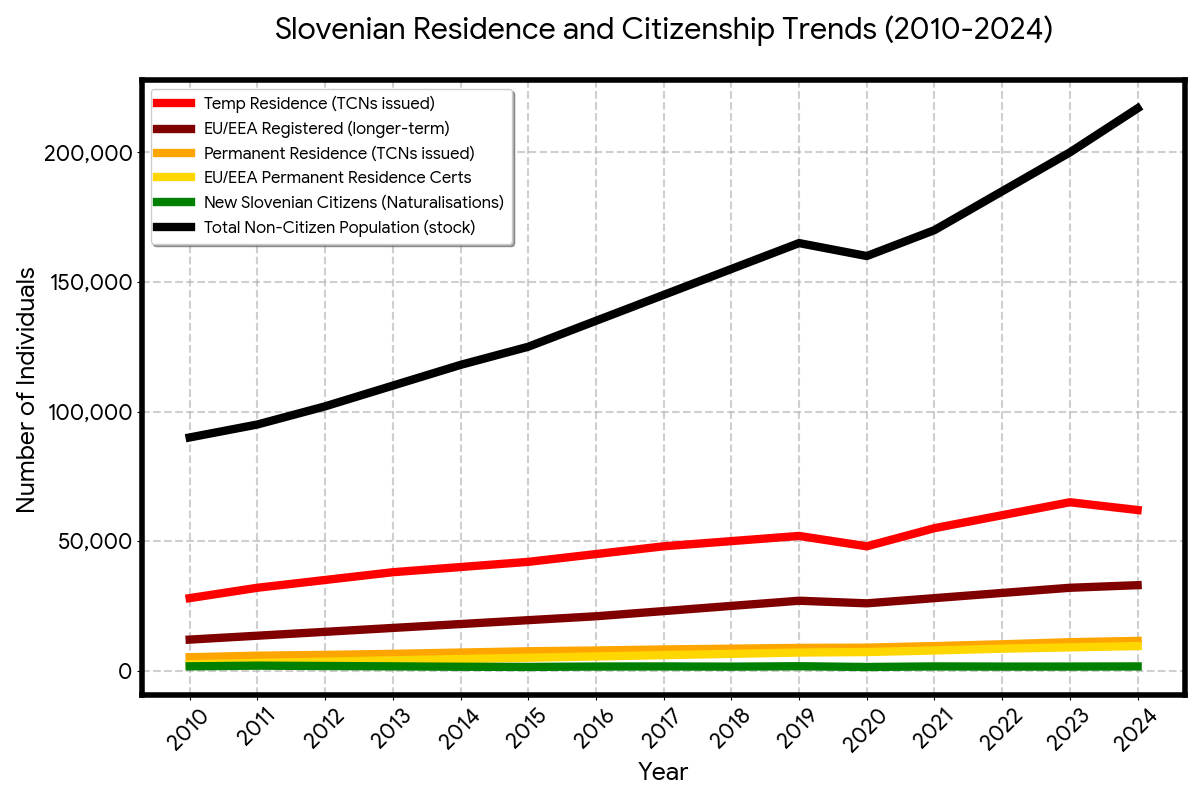
The following is based on SURS migration statistics (tables 05N3121S, 05I200
series), SURS population by citizenship (05E1008S and similar), Eurostat
residence permits data (migr_resfirst and tps00171), and Migration
Directorate (MNZ) annual reports for permit issuance.
Under Article 16, Slovenia's language test requirement was not, given
Slovenia's refusal, merely ludicrous and disproportionate under 2004/38/EC
— it was categorically impermissible.
A Member State cannot impose any condition on EU-citizen permanent residence
beyond the five-year residence threshold. The language test was simply
illegal.
Integration is a national competence. No accredited TSFL qualification
exists in Slovenia. No national curriculum has been published. The
complainant has seen no evidence of a teaching method in action, nor anybody
willing to invest the time, effort, or go through the grief of what they
generally believe to be a pointless exercise and thankless task.
Instead of a fun and interesting thing, Slovenia has chosen to make learning
a not particularly atypical Indo-European language a legalistic proof of the
inferiority of foreigners.
In view of the factual situation, the weaponization of Slovene to prevent
accession to permanent residence status is non-pragmatic, unreasonable and
disproportionate. Course provision in the Podravska region has been and
remains negligible.
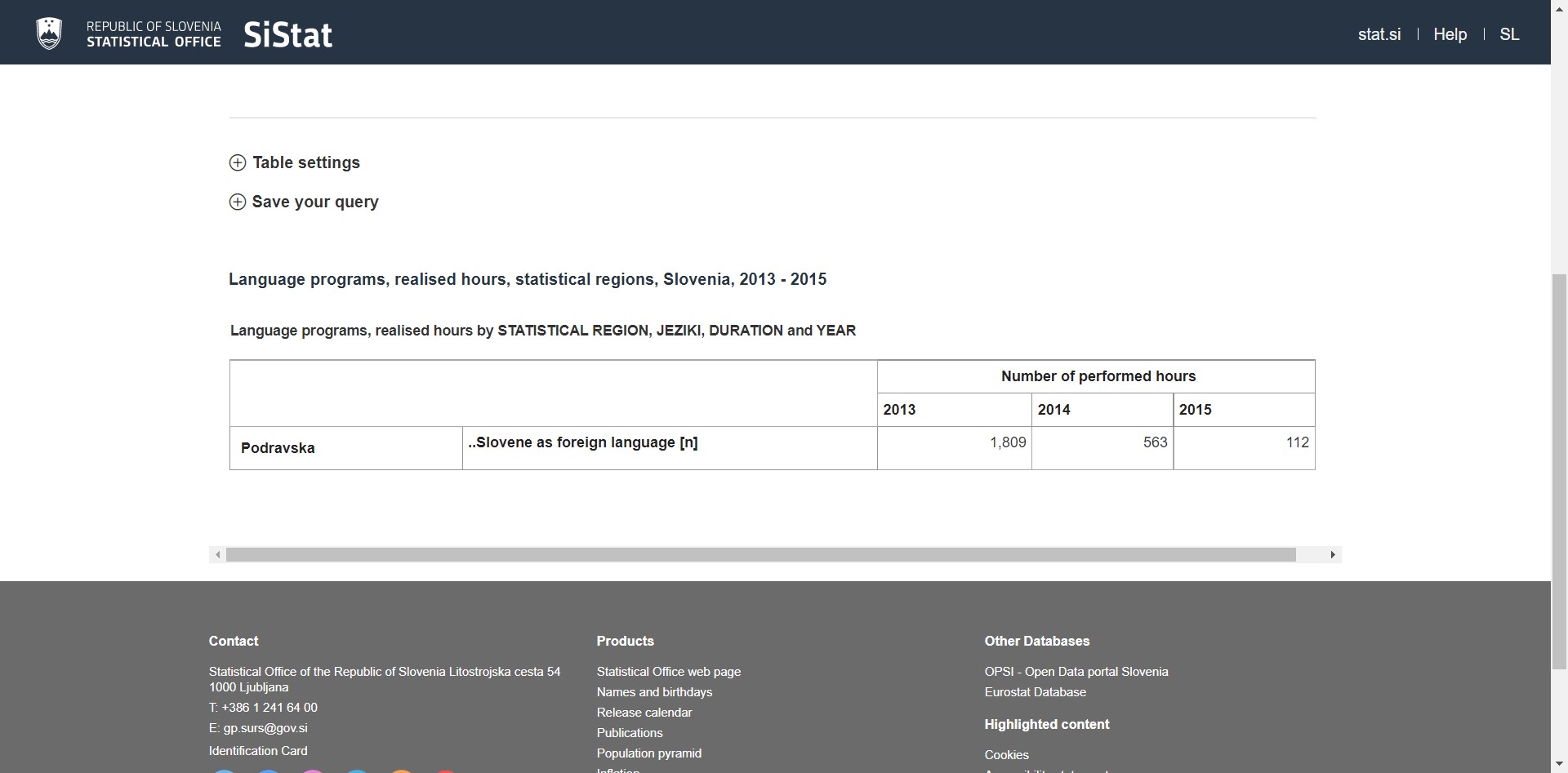
Regional data for Podravska shows 2 hours and 9 minutes of Slovenian
language instruction per week for all pupils in 2015.
Across the three-year period 2013–2015, total provision in Podravska
amounted to 2,484 teaching hours — less than 16 hours per week in
aggregate across all learners.
The Slovenian "academic hour" = 45 minutes, making actual provision lower
than the nominal hour figures suggest.
Over these three years Podravska had 35 courses of which 6 were counted as
"over 100 hours".
In general, if T is the total delivered teacher-hours over a nine-month
period and N is the number of pupils to be served, the implied average class
size C would be C = ( N × 180 ) / T.
On 11 June 2022 countrymeters.info showed Slovenia with a total population
of 2,086,214 residents.
In the unlikely event their composition by ethnicity remained the same as
the last known count in 2002, 16.9% i.e. 352,570 did not have Slovene as
their mother tongue in 2022.
Eurydice, also obliged to rely on this 20 year old data from Slovenia, did
not make much sense when it claimed on 1 December 2021 that 88-92% used
Slovenia as their primary language.
2024: ~89.7%
(SURS Jan 2025: foreign citizens up 11,700)
2026 (1 Jan):
89.5% (stat.si )
The
dashed line is a polynomial fit through the confirmed points.
Returning to our 2022 cohort of 2,086,214, 93% are estimated to
be actual immigrants or foreign-origin residents.
SURS, reporting on 13 December 2021, explains 46% of 292,824 born abroad
were actually Slovenian citizens. "Some were born Slovenian citizens (e.g.
children of Slovenians who lived abroad), while others acquired citizenship
through naturalisation."
The remaining 54% potential language pupils of 2022 are further broken down
on the basis of these 2021 figures:
54% of 93% of 16.9% of 2,086,214 is 176,869 potential pupils.
But an immigrant's Slovenian citizenship is not a guarantee of their
practical knowledge or experience of Slovene. Treating the 46% of
foreign-born residents who are Slovenian citizens and the statistically
non-immigrant 7% as not needing language support makes the cohort estimate
terminally conservative; a plausible upper bound is the full 352,570
residents without Slovene as their mother tongue.
With 208 teachers recorded in 2021 and the conservative potential learner
pool of 176,869, this corresponds to about 850 potential pupils per teacher.
Teacher complement data exists for 2021, but delivered teaching-hours for
2021/22 are not available in the cited datasets; therefore per-teacher
weekly instruction for 2021/22 cannot be stated directly. Any estimate would
require assuming system-wide delivered-hours similar to the 2013–2015
average of 5,320 hours/year (the only delivered-hours figure available).
Under that assumption, the implied delivered teaching time averages only
0.49 hours per week per listed teacher (≈29.5 minutes/week).
Continuing with the same cohort and assumption, the implied instructional
time available per potential learner is only ≈2.08 seconds per week
(or ≈1.04 seconds/week if the cohort is taken as the full 352,570
non-mother-tongue population).
Pupils per teacher is a headcount ratio:
176,869 / 208 ≈ 850 pupils
0.49 hours/week per teacher comes from taking the same fixed annual total
and dividing by teachers and weeks:
5320 / 208 / 52 ≈ 0.492 hours/week/teacher
2.08 seconds/week per pupil comes from taking that same fixed annual total
and dividing by pupils and weeks
Slovenia’s official data on Slovenian language courses is sparse.
Detailed "performed hours" statistics are only publicly available for the
years 2013–2015 in SURS 0953806S.
Teacher numbers were obtained from SURS PX-Web table 0764805S. Pre-2010
statistics from 0744405S are not directly comparable.
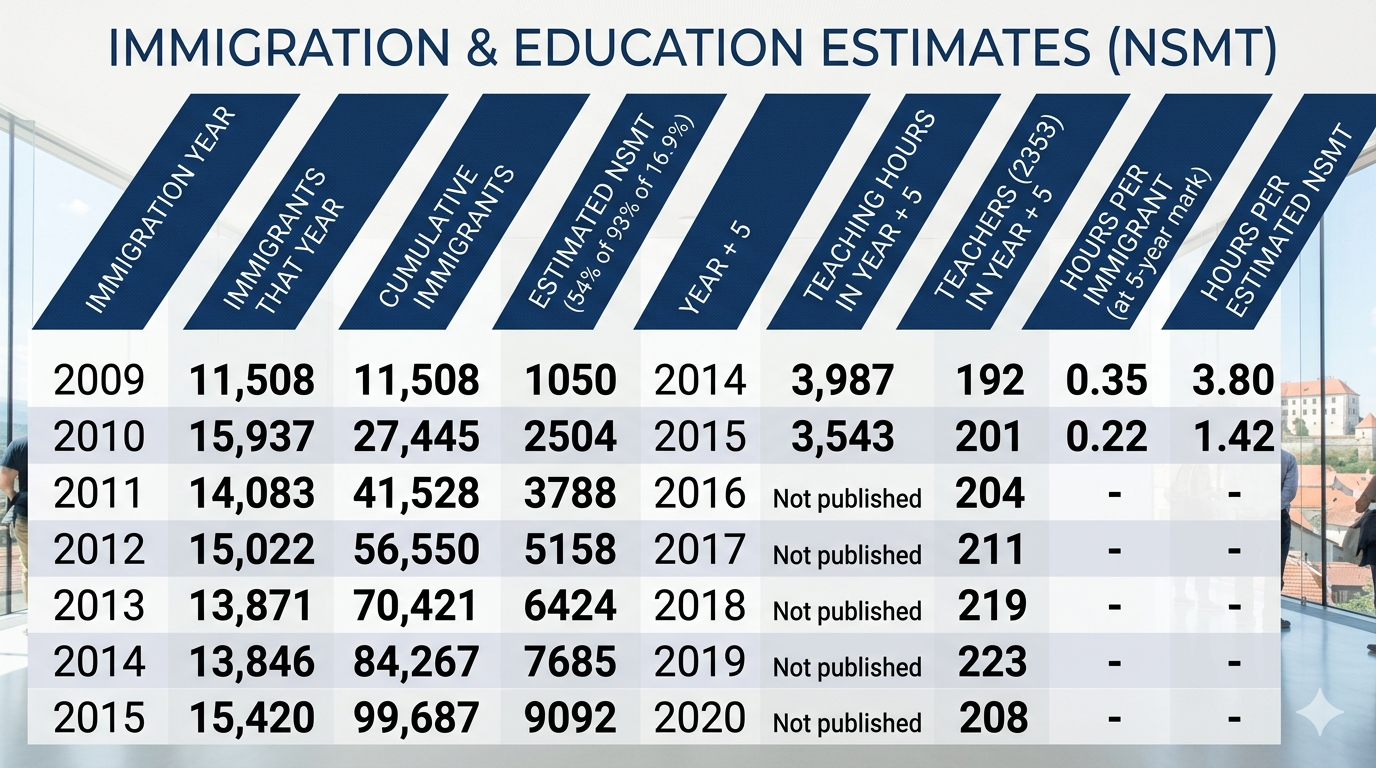
Using what we have, we compare teaching hours delivered five years after
arrival with the scale of immigration in each cohort.
Teaching hours data exists for 2013 (8,429 hours nationally) but the 2008
annual immigration figure from a comparable series was not available at time
of drafting; the 2013 cohort row has therefore been omitted pending
verification.
It might be judged unrealistic to think immigrants would wait five years
before learning a language. But as this rolling five-year cohort analysis
shows, Slovenia is prepared to wait much longer:
In 2014 (five years after the 2009 cohort arrived), there were only 3.80
hours of Slovenian language teaching per estimated NSMT individual.
In 2015 (five years after the 2010 cohort), this fell further to 1.42 hours
per estimated NSMT individual.
37,514 (70%) of the 2008/9 intake had not left or died by 2015.
The official commentary frames citizenship rates this way:
"2,600 (5%) foreigners acquired citizenship, 85% of them are still living in
Slovenia. So citizenship of the host country is the factor with negative
influence on further international mobility."
Translated, this says that of those who arrived in 2008/9, only 2,600 had
naturalised by November 2017, i.e. 8 to 9 years later.
Slovenia's statistics are evasive and suspiciously incomplete, although the
static number of registered teachers is a strong clue to the persistent
apathy in the area of Slovene acquisition, especially when compared to
immigration growth.
There is no official figure for non-Slovenian speakers. There is no register
of persons qualified to teach Slovene as a foreign language in Slovenia. The
Center for Slovene as a Second and Foreign Language does not publicise its
intakes or graduate numbers. After 2015, Slovenia's flirtation with counting
teaching hours apparently ceased due to the low-to-no priority and
unpopularity of the concept, making further direct comparisons impossible.
Let us at one extreme suppose only the 2,600 new citizens eventuating from
the arrivals of 2008/9 used all the 15,959 hours performed in 2013-2015.
15959/2600 = a total 6.14 hours of teaching per pupil for a 180 hour course.
At the other extreme we suppose the teaching hours are divided among all the
2008/9 arrivals remaining by 2015.
15959/37514 is 0.425 hours' teaching per pupil, which is 26 minutes for a
180 hour course.
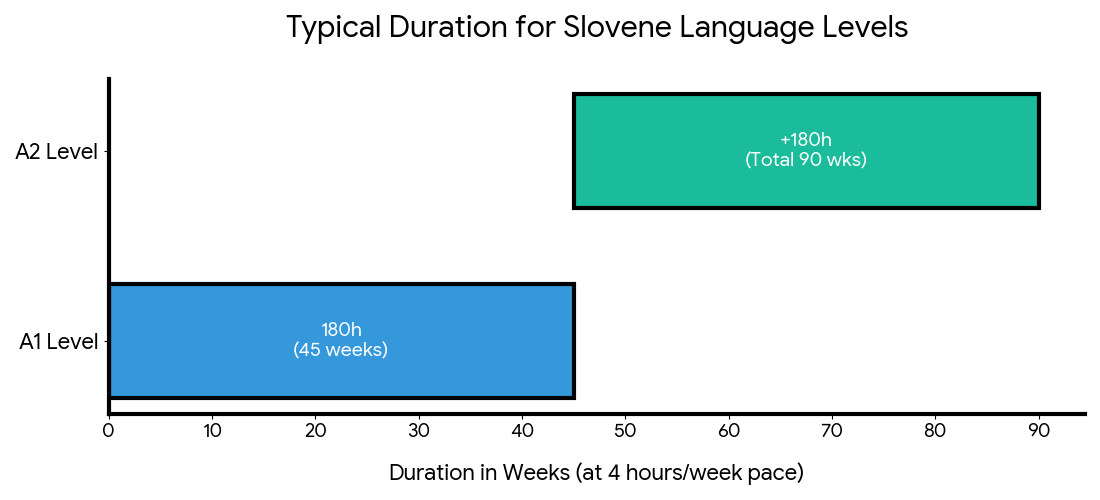
The state's own published standard requires 180 hours for A1 certification.
The complainant doesn't accept this, but assuming a teacher can be found
with any kind of method, equipment or routine, Slovenia's opinion of a
sensible pace is often two 2-hour sessions per week.
Four hours of weekly study is 6,923 times more than 2.08 seconds. The
implied class sizes make the structural failure concrete:
To give every one of the 37,514 pupils a full 180-hour course, the total
pupil-hours required would be 37,514 pupils × 180 hours = 6,752,520
pupil-hours.
To deliver the full 180 hours for the 37,514 pupils in the 15,959 teaching
hours actually delivered in 2013–2015, the required average class size
would be: 6,752,520 ÷ 15,959 ≈ 423 pupils per class.
The state cannot simultaneously impose a language test as a condition of
permanent residence and decline to provide the means of meeting it. That
contradiction is not a national competence; it is a structural breach of the
proportionality requirement under both 2004/38/EC (as applied to the
complainant's EU-citizen period) and 2003/109/EC (for the post-Brexit
period).
The complainant has been on the receiving end of such contradictions for
seventeen years. From early in the complainant's residence, the UE
communicated that a language test would be required for permanent residence.
This was false as a matter of EU law: no such condition is permissible under
Article 16 of Directive 2004/38/EC.
Repeated assertion of its requirement was, at best, wishful thinking on the
part of the authorities or individuals, at worst, a misrepresentation that
caused the complainant to act in reasonable reliance on this
misrepresentation for a substantial period, making no application for
permanent status in the belief that the language test was a lawful as well
as practically insurmountable obstacle.
At 2.08 seconds per learner per week, Slovenia's teaching input fell 6,923
times short of the four hours it nominally expected learners to study.
In 2020 the complainant was enrolled by the ZRSZ in a state-funded Slovenian
language course at the People's University of Ptuj (Ljudska univerza Ptuj,
LUP), at a potential cost to taxpayers of approximately €9635 to public
funds.
After months of anticipation the class was found to consist almost entirely
of students who, according to LUP, had already completed 60 hours of
Slovenian — though no evidence of this was apparent.
The session began entirely in Slovenian without any explanation in a
language the complainant could understand. There was no language teaching.
No starter phrases. No nothing. No participation was requested from the
class. Instead the speaker just delivered some kind of general blah. Hope
faded as the actual teaching bit receded into the future.
Before the 1-hour "class" ended after 20 minutes, the complainant and two
other non-Albanian-speaking students expecting English to be the base
language and to actually learn Slovene revealed their confusion to the
surprised staff, and were informed they were in the wrong place, "not
viable" and excluded.
This was the repeat of the 2008 rejection the ZRSZ promised would not be
repeated. In 2008 the educators' justification for sending the complainant
away was that the student must speak Hungarian, Italian or - as LUP put it -
'Serbo-Croat'.
Yugoslav-era labour migration and minority ethnicities with political and
language status within Slovenia were therefore the petrified determinants of
LUP's offer. English was somewhere else in their language hierarchy and an
object of pursuit, not displacement.
LUP and ZRSZ tried blaming each other for the second act of this farce, but
the complainant was ready for this with a reading of their legal
obligations.
The ZRSZ were not going to teach it themselves. Individual tuition was
therefore grudgingly arranged. But LUP had no curriculum, language teacher,
language teaching experience, textbook, or teaching time. No course existed.
Any expectation of forward momentum was politely treated as a bit of a
nuisance.
LUP were, however, keen to get a signature, to get the €9,600 cited in
committee discussions on the new language test legislation (EPA 530-IX) as
the cost of an A1 course. The complainant declined to sign.
The financial flows between state bodies and course providers for programmes
that do not materialise warrant independent scrutiny.
This illustrates with precision the structural disconnect between Slovenia's
formal integration obligations and their practical implementation: public
funds are disbursed in a money-go-round, certificates are issued, and
nothing happens.
Overall the complainant finds the community too busy right now and opposed
to teaching Slovene. Apparently, this is not a thing.
Instead of a fun and interesting thing, Slovenia has chosen to make learning
a not particularly atypical Indo-European language a "proof" of the
inferiority of foreigners. Instead of a practical syllabus, Slovenia has
weaponized Slovene and intends to continue claiming what immigrants must do
is too difficult.
The Government cannot be unaware it is building castles in the air.
Misinformation, temporary status, denied health insurance, and
non-instruction in a language its owners are unequipped to teach compound
one another throughout this complaint.
The misrule is exploitative. No limitation on the grant of right can be
justified under Article 52(1) CFREU. The denial was not provided for by law
— no Slovenian statutory provision authorised exclusion of a legally
resident EU citizen from the compulsory health insurance system on grounds
of administrative convenience.
Slovenia did not respect the essence of the right, extinguishing it entirely
for fifteen years and six days rather than qualifying it. This meaningless
interregnum was not necessary. Nor did it genuinely meet any objective of
general interest recognised by the Union. Nor did it protect the rights or
freedoms of others.
Under Article 52(1) CFREU, whatever Slovenia might protest about the
language certification requirement serving a pro-integrative objective under
Article 79 TFEU, that argument fails the genuineness test: a state that
imposes language as an integration condition while providing 2.08 seconds of
language instruction per potential learner per week is not pursuing
integration. It is manufacturing an obstacle.
The 2008–2009 immigration cohort analysis confirms this pattern: of
53,673 who arrived that year, 95% had not naturalised by 2017 despite eight
to nine years of residence.
The combination of residency criterion for full insurance access, and
language test while courses are not adequately provided creates a systemic
trap affecting hundreds of thousands of residents cumulatively over the
years since accession.
Many of the 99 out of every 100 arrivals who remain unable or uninterested
in "becoming Slovenian" probably have stories to tell about the
above-described topics.
Collectively and in combination, maladministration in the areas of
registration and re-registration, residence status, health insurance,
welfare, language provision, and language restriction has created
insuperable structural obstacles to the complainant's EU-law rights and
desire to assimilate.
Regardless of the inevitable homegrown legality of Slovenia's cracks for its
not-Slovenian-enough residents to fall into, the actual detriment to the
latter in practice is what counts in EU rights law.
The complainant submits that the violations set out above are
straightforward and asks the Commission to adjudicate accordingly.
TIMELINE
15 Jul 1964
Judgment in Costa v ENEL
28 Jan 1981
Convention for the Protection of Individuals with regard to Automatic
Processing of Personal Data (Convention 108)
14 May 1993
Slovenia joins Council of Europe
7 August 1999
ZVOP 59/1999 enters in force
12 Feb 2004
2003/109/EC enters into force
30 Apr 2004
2004/38/EC enters into force
1 May 2004
Slovenia's accession to the EU
1 May 2004
obligation to transpose 95/46/EC as part of the acquis
on or after 5 Aug 2004
Zakon o javni rabi slovenščine (ZJRS) enters into force
1 Jan 2005
entry into force of ZVOP-1 (Slovenia's implementation of 95/46/EC)
29 Apr 2005
Complainant establishes in Slovenia
29 Apr 2005-9 Oct 2018
Counterfactually, the UE continues to insist the complainant "really" lives
in England.
16 May 2005
First registration in Ptuj
Dec 31 2005
Slovenia appoints first Information Commissioner
23 Jan 2006
2003/109/EC transposition deadline
3 Mar 2006
Second registration in Ptuj
30 Apr 2006
2004/38/EC transposition deadline
14 Sep 2006
Constitutional Court decision in U-I-234/04
2008
No Slovene lessons allowed due to not speaking Hungarian, Italian or
Serbo-Croat
2008-2016
GT Statistical Machine Translation in Slovene often a disaster
15 Jul 2008
Decree on the Integration of Aliens 65/08, 86/10, 50/11 – ZTuj-2 and
70/12
18 Jul 2008
Third registration. UE states five years starts again
1 Dec 2009
Charter of Fundamental Rights enters into force with Treaty of Lisbon
4 Mar 2010
Judgment in C-578/08 Chakroun
29 Apr 2010
Actual five year expiry date
1 May 2010
Regulation 883/2004 enters into force
11 Jun 2010
Fourth registration
3 Aug 2011
Fifth registration
22 Oct 2012
Sixth registration
16 Apr 2013 Las v PSA Antwerp: Grand Chamber judgment
18 Jul 2013
End of incorrectly restarted five years
27 Apr 2016
Regulation 2016/679 was adopted
Nov 2016-now
Google Translate (GT) Neural Machine Translation
29 Mar 2017
UK invokes TEU Article 50
2017–2018
GT GNMT optimization
25 May 2018
Regulation 2016/679 becomes applicable replacing Directive 95/46/EC
9 Oct 2018
Permanent residence granted 8 years, 5 months, 10 days after the Article 16
entitlement arose
3 Oct 2019
Judgment in C-302/18 X v. Belgische Staat
2022–2024
GT gets large language models, context, idioms, vikanje/tikanje
from 27 Apr 2023
Slovene A1 required for permanent residence under 43/2023, applies to TCNs
but not EU/EEA citizens
from Nov 2024
Permanent residence requires A2 for TCNs only
2025
Dash for data for LLM after new ZJRS-B penalties
2025-now
Hyper-context, some dialects, GT still not AI enough
5 May 2025
Complainant enters health insurance system 6 years 6 months and 27 days
after achieving permanent residence, 8 years 1 month 7 days after Article
50, 11 years 9 months 18 days after the end of the incorrectly restarted
five years, and 15 years 6 days late in law.
24 Jun 2025
Seventh registration/first biometric ID card, not shown in UE printout 17
Apr 2026
29 Apr 2026
This complaint
Value of missed DSP payments May 2010 to January 2020 with 8% annual
interest compounded monthly
117 monthly missed payments
€31,516.28 Principal
8% p.a. compounded monthly
€15,089.10 Interest to 31 Jan 2020
Total claim at 31 Jan 2020
€46,605.38 Principal + interest
Month Rate €/mo
Interest €
Cumulative total €
May 2010 226.80
0.00 226.80
Jun 2010 226.80
1.51 455.11
Jul 2010 226.80
3.03 684.95
Aug 2010 226.80
4.57
916.31
Sep 2010 226.80
6.11
1,149.22
Oct 2010 226.80
7.66 1,383.68
Nov 2010 226.80
9.22 1,619.71
Dec 2010 226.80
10.80
1,857.31
Jan 2011 226.80
12.38
2,096.49
Feb 2011 226.80
13.98
2,337.26
Mar 2011 226.80
15.58
2,579.65
Apr 2011 226.80
17.20
2,823.64
May 2011 226.80
18.82
3,069.27
Jun 2011 226.80
20.46
3,316.53
Jul 2011 230.61
22.11
3,569.25
Aug 2011 230.61
23.79
3,823.65
Sep 2011 230.61
25.49
4,079.76
Oct 2011 230.61
27.20
4,337.56
Nov 2011 230.61
28.92
4,597.09
Dec 2011 230.61
30.65
4,858.35
Jan 2012 260.00†
32.39 5,150.74
Feb 2012 260.00†
34.34
5,445.08
Mar 2012 260.00†
36.30
5,741.38
Apr 2012 260.00†
38.28
6,039.65
May 2012 260.00†
40.26
6,339.92
Jun 2012 260.00†
42.27
6,642.18
Jul 2012 260.00†
44.28
6,946.46
Aug 2012 260.00†
46.31
7,252.77
Sep 2012 260.00†
48.35
7,561.13
Oct 2012 260.00†
50.41
7,871.53
Nov 2012 260.00†
52.48
8,184.01
Dec 2012 260.00†
54.56
8,498.57
Jan 2013 260.00†
56.66
8,815.23
Feb 2013 260.00†
58.77
9,133.90
Mar 2013 260.00†
60.89
9,454.89
Apr 2013 260.00†
63.03
9,777.92
May 2013 260.00†
65.19
10,103.11
Jun 2013 260.00†
67.35
10,430.46
Jul 2013 260.00†
69.54
10,760.00
Aug 2013 260.00†
71.73
11,091.73
Sep 2013 260.00†
73.94
11,425.68
Oct 2013 260.00†
76.17
11,761.85
Nov 2013 260.00†
78.41
12,100.26
Dec 2013 260.00†
80.67
12,440.93
Jan 2014 260.00†
82.94
12,783.87
Feb 2014 260.00†
85.23
13,129.09
Mar 2014 260.00†
87.53
13,476.62
Apr 2014 260.00†
89.84
13,826.46
May 2014 260.00†
92.18
14,178.64
Jun 2014 260.00†
94.52
14,533.16
Jul 2014 260.00†
96.89
14,890.05
Aug 2014 269.20
99.27
15,258.52
Sep 2014 269.20
101.72
15,629.44
Oct 2014 269.20
104.20
16,002.84
Nov 2014 269.20
106.69
16,378.72
Dec 2014 269.20
109.19
16,757.12
Jan 2015 269.20
111.71
17,138.03
Feb 2015 269.20
114.25
17,521.48
Mar 2015 269.20
116.81
17,907.49
Apr 2015 269.20
119.38
18,296.08
May 2015 269.20
121.97
18,687.25
Jun 2015 269.20
124.58
19,081.03
Jul 2015 269.20
127.21
19,477.44
Aug 2015 269.20
129.85
19,876.49
Sep 2015 269.20
132.51
20,278.20
Oct 2015 269.20
135.19
20,682.59
Nov 2015 269.20
137.88
21,089.67
Dec 2015 269.20
140.60
21,499.47
Jan 2016 269.20
143.33
21,912.00
Feb 2016 269.20
146.08
22,327.28
Mar 2016 269.20
148.85
22,745.33
Apr 2016 269.20
151.64
23,166.16
May 2016 269.20
154.44
23,589.80
Jun 2016 269.20
157.27
24,016.27
Jul 2016 269.20
160.11
24,445.58
Aug 2016 292.56
162.97
24,901.11
Sep 2016 292.56
166.01
25,359.68
Oct 2016 292.56
169.06
25,821.30
Nov 2016 292.56
172.14
26,286.00
Dec 2016 292.56
175.24
26,753.80
Jan 2017 292.56
178.36
27,224.72
Feb 2017 292.56
181.50
27,698.78
Mar 2017 292.56
184.66
28,176.00
Apr 2017 292.56
187.84
28,656.40
May 2017 292.56
191.04
29,140.00
Jun 2017 292.56
194.27
29,626.83
Jul 2017 292.56
197.51
30,116.90
Aug 2017 297.53
200.78
30,615.21
Sep 2017 297.53
204.10
31,116.84
Oct 2017 297.53
207.45
31,621.82
Nov 2017 297.53
210.81
32,130.16
Dec 2017 297.53
214.20
32,641.89
Jan 2018 297.53
217.61
33,157.03
Feb 2018 297.53
221.05
33,675.61
Mar 2018 297.53
224.50
34,197.64
Apr 2018 297.53
227.98
34,723.16
May 2018 297.53
231.49
35,252.17
Jun 2018 297.53
235.01
35,784.72
Jul 2018 297.53
238.56
36,320.81
Aug 2018 297.53
242.14
36,860.48
Sep 2018 297.53
245.74
37,403.75
Oct 2018 297.53
249.36
37,950.64
Nov 2018 297.53
253.00
38,501.17
Dec 2018 297.53
256.67
39,055.38
Jan 2019 297.53
260.37
39,613.27
Feb 2019 297.53
264.09
40,174.89
Mar 2019 297.53
267.83
40,740.26
Apr 2019 297.53
271.60
41,309.39
May 2019 297.53
275.40
41,882.31
Jun 2019 297.53
279.22
42,459.06
Jul 2019 297.53
283.06
43,039.65
Aug 2019 297.53
286.93
43,624.11
Sep 2019 297.53
290.83
44,212.47
Oct 2019 297.53
294.75
44,804.75
Nov 2019 297.53
298.70
45,400.98
Dec 2019 297.53
302.67
46,001.18
Jan 2020 297.53
306.67
46,605.38
TOTAL — 31 Jan 2020 €31,516.28 €15,089.10 €46,605.38
† Jan 2012–Jul 2014: €260.00 estimated (ZSVarPre basic
amount; verify against Uradni list RS). Confirmed rates from official
Slovenian sources: €226.80 (Jul 2009–Jun 2011); €230.61
(Jul–Dec 2011); €269.20 (Aug 2014–Jul 2016); €292.56
(Aug 2016–Jul 2017); €297.53 (Aug 2017–Jan 2020).
Interest method: running balance × (1 + 0.08/12) + missed payment each
month. Reference date: 31 Jan 2020.
Figures represent denied welfare access as a quantum reference for
Francovich / Article 26 URS purposes.